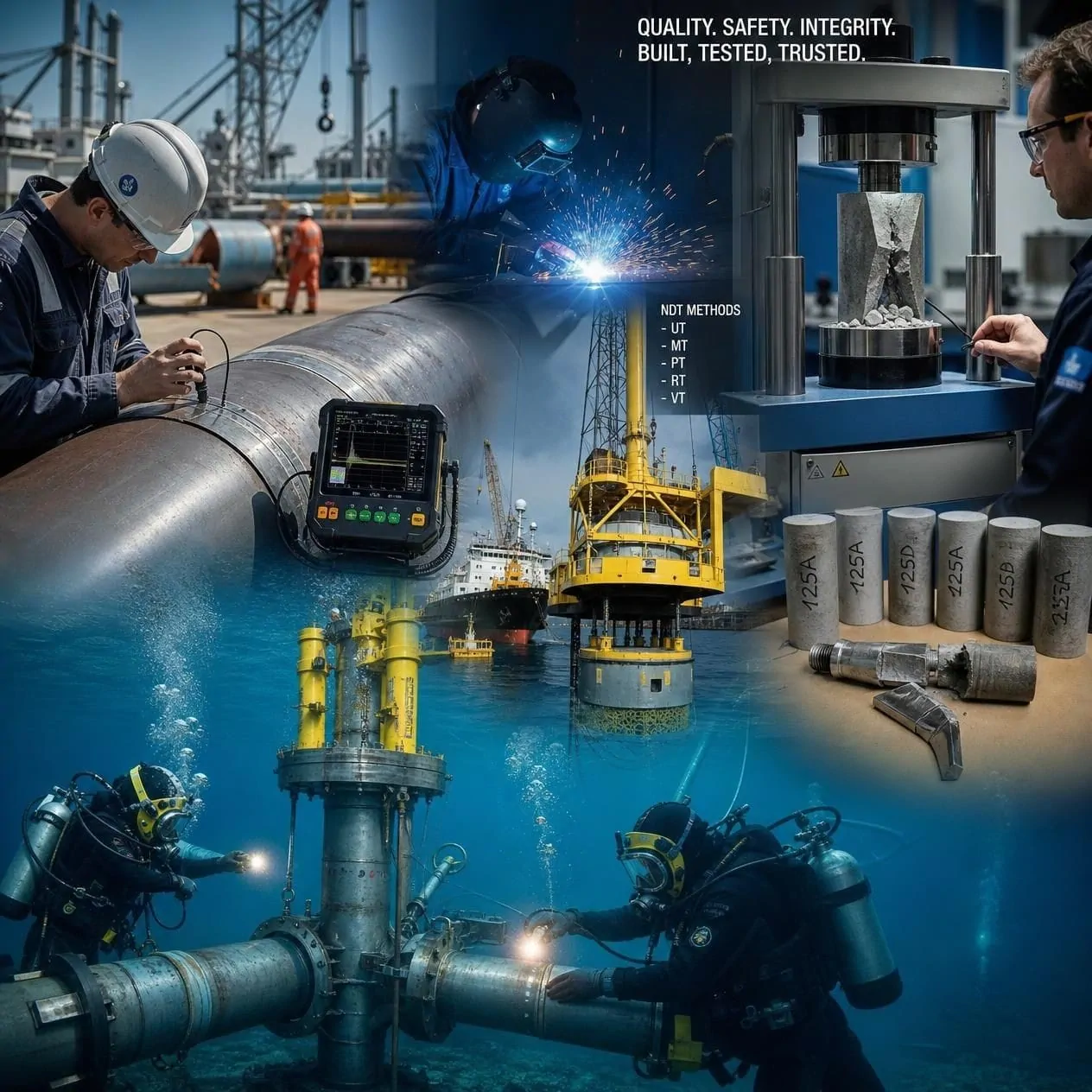
Destructive and non- destructive tests. Construction and underwater assembly.
Destructive Testing (DT)
Tests materials or components by applying loads or conditions that may damage or destroy the test specimen.
Used to determine properties such as strength, toughness, hardness, and weld performance.
Helps verify that materials and welded joints meet required specifications.
Non-Destructive Testing (NDT)
Inspects materials and structures without causing permanent damage.
Methods can include ultrasonic testing, magnetic particle testing, dye penetrant testing, radiography, and visual inspection.
Detects cracks, corrosion, weld defects, and other discontinuities.
Commonly used for hull structures, pipelines, welds, machinery, and underwater components.
Construction and Underwater Assembly
Covers the installation, joining, and repair of underwater structures and components.
May include underwater welding, cutting, bolting, fitting, alignment, and installation of structural elements.
Used for marine structures, pipelines, offshore equipment, docks, and vessel components.
Requires qualified personnel, specialised equipment, proper procedures, and appropriate safety controls.